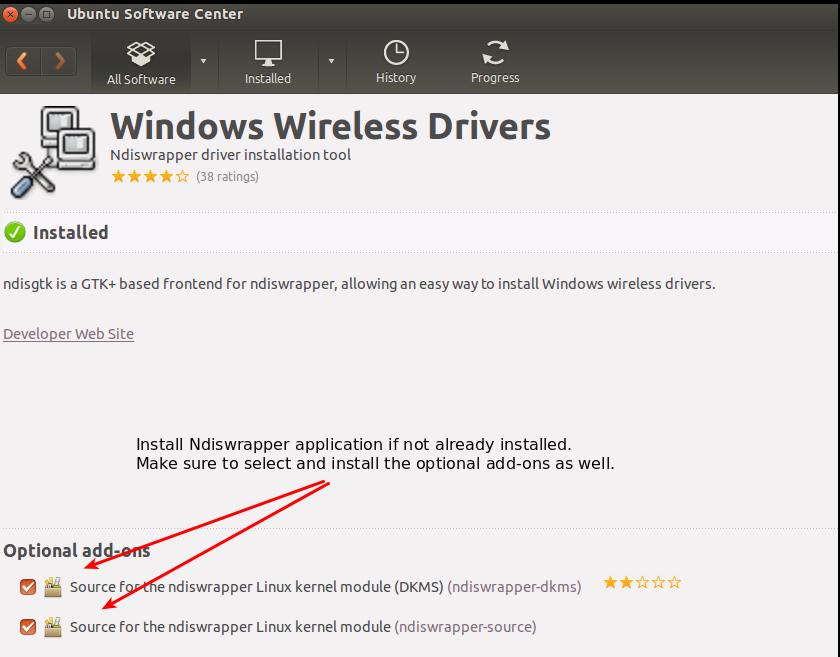
Install Ndiswrapper Without Internet Debian Wheezy
Put the fun back into computing. Use Linux, BSD. Taking Ubuntu 1.
Ubuntu is one of the more widely used GNU/Linux distributions in the world with the project's parent company, Canonical, reporting around 3. Ubuntu pre- installed in the past two years. Ubuntu, along with its many community editions, continues to be used by millions around the world and the decisions made by Ubuntu developers have an direct impact on many computer users. The latest release of Ubuntu, version 1. October 2. 3rd and the release notes painted a picture of a tame release with minor changes from Ubuntu's previous version. Most components, including the Linux kernel and Firefox, received minor updates. Ubuntu 1. 4. 1. 0 features a short, nine month life cycle, and the release notes warn us changes have been made which make it less likely we can use the USB Creator utility to write certain USB images to thumb drives.
Linux wireless LAN support. Wireless Adapter Chipset Directory compiled by HJ Heins Last updated on 21 January 2016.
Manufacturer Name Hardware description Distro support Works w/o hub AP mode Ad hoc Notes Debian Raspbian Other 3COM 3CRUSB10075 ZyDAS zd1211rw.
There are also countless community variations of Ubuntu. The distribution is available in 3.
- What to do if a Debian web page is in the wrong language. The first and most common reason why a document is received in the wrong language from the Debian web server.
- Welcome to this year's 44th issue of DistroWatch Weekly! The Ubuntu operating system is a fast moving, experimental Linux distribution that, for the past ten years.
The ISO image for the Desktop edition is 1. GB in size and this is the image I downloaded. I feel it is worth pointing out that Ubuntu recommends most users stick with long term support (LTS) releases, which are released every two years and are supported for five years.
Non- LTS releases, such as this one, are provided more for the benefit of developers and people who like to have access to the latest features and hardware support. Ubuntu 1. 4. 1. 0 - Unity desktop with default theme(full image size: 1,0. B, screen resolution 1.
Booting from the Ubuntu live media brings up a graphical page where we are asked to select our preferred language from a list. We are also given the choice to either try working with the live Unity desktop or launching straight into the project's system installer. I decided to play with the live desktop environment first. When Unity loads we are shown a screen with a list of keyboard short- cuts. These short- cuts give us access to various Unity features and assist us in manipulating application windows.
When this page of short- cuts is dismissed we see a quick- launch bar (that doubles as a task switcher) on the left side of the screen. The system tray and a button for accessing the settings panel sit in the upper- right corner and the Unity Dash, a location for finding files and launching applications, is located in the upper- left corner. Launching Ubuntu's graphical system installer brings up a screen where we are asked to select our preferred language and, optionally, we can click a link to view the project's release notes in our web browser. The next screen of the installer asks if we would like to download software updates during the install process.
We can also choose to install third- party multimedia support during the install process. The next page covers partitioning. The Ubuntu installer offers to partition our hard drive for us, optionally using LVM volumes and encryption. Alternatively, we can manually partition the drive and this is the option I chose. Ubuntu has a very straight forward approach to partitioning and I find the installer's method of getting us to select file systems and mount points easy to navigate. I decided to set up my copy of the operating system on the Btr file system with a small swap partition.
Once we have partitioned the hard drive the Ubuntu system installer begins to copy its files to our disk while we are asked some more questions. We are asked to confirm our time zone or select a new time zone from a map of the world.
We are asked to confirm our computer's keyboard layout and we are asked to create a user account for ourselves. We can choose at this time to encrypt our home directory. Then we wait a few minutes for the installer to finish its work. When the installer is done we are asked to reboot the computer. Ubuntu 1. 4. 1. 0 - the System Settings panel(full image size: 9.
B, screen resolution 1. Booting into our locally installed copy of Ubuntu brings us to a graphical login screen where we can sign in as the user we created minutes before or we can login as a guest. The operating system's guest account is not protected by a password and is wiped clean after every use. A few things I noticed upon logging in were that, first, Unity feels a big more responsive now than it has in the past. Second, the Dash still includes on- line search results when we type search terms. On- line search can be disabled through the distribution's System Settings panel.
Shortly after logging in I was notified there were software updates available. The Ubuntu update manager is a compact utility which displays a brief summary of available updates. We can check boxes to indicate which items we wish to download. We can also click on an update's entry to get more detailed information about the new software.
On the day I installed Ubuntu there was just one update available and it was less than 1. MB in size. I tried running Ubuntu 1. Virtual. Box virtual machine. When running on physical hardware, Ubuntu performed well. The desktop was responsive, sound worked out of the box and my screen was set to its maximum resolution. Unity operated smoothly and I encountered no problems.
In the Virtual. Box environment Ubuntu worked properly, but there were two small problems. The first was Ubuntu's screen resolution was very low (about 8. I think) in Virtual. Box until Virtual. Box guest add- ons were installed. The second issue I found was that the Unity desktop, especially the Dash, was sluggish in the virtual machine until 3- D acceleration was enabled. Once 3- D video acceleration was enabled Unity performed well.
In both environments Ubuntu required approximately 4. MB of RAM when logged into the Unity desktop. Ubuntu ships with several useful and popular open source applications. We are given the Firefox web browser and, assuming we enabled third- party multimedia support during the installation of the distribution, Flash is also included. The Libre. Office productivity suite is provided for us along with the Thunderbird e- mail client and a document viewer. The Totem video player, the Rhythmbox audio player and the Brasero disc burner are installed by default. With third- party multimedia codecs enabled these players can handle popular media formats.
I found an archive manager, a text editor, a calculator and a backup utility installed. There are also a few small games, the Orca screen reader application and the Transmission bittorrent software. Network Manager is available to help us get on- line. I didn't find Java installed, but I did find the GNU Compiler Collection installed along with the usual command line utilities, manual pages and the Linux kernel, version 3. Earlier in the year, the Ubuntu team announced they would be following Debian's example and adopting systemd in the future. I was curious, going into this trial, whether Ubuntu would ship with the Upstart init software or if the distribution had switched over to systemd. A quick check showed systemd processes to be running on the system and running .
However, looking at the init process itself revealed Upstart is still responsible for bringing the operating system on- line. It appears as though Ubuntu is adopting pieces of systemd, using it to maintain compatibility with some software while relying on the older Upstart software to act as init. Ubuntu 1. 4. 1. 0 - finding packages through Software Centre(full image size: 7. B, screen resolution 1. Managing software on Ubuntu is handled through the Software Centre.
This application allows us to search through categories of software and locate packages by name or by function. We can click on a package's entry to bring up detailed information about our selection, complete with user reviews and screen shots.
We can add or remove software from the system with the click of a button. Pinnacle Studio Free Download Full Version For Xp. Actions performed on packages happen in the background while we continue to browse through the Software Centre.
One aspect of the Software Centre I like is that it will make recommendations to us based on popular downloads.
Debian web site in different languages. Obviously, not everyone in the world uses the same language.
As the. web grows it is becoming more common to find pages that are available. A standard was therefore introduced, called. The actual version delivered is negotiated. Note that selecting a different language (from the available translations.
It does not change the default language. If you click a. link to a different page, it will be shown in the original language again. This is a. growing problem as more ISPs see caching as a way of decreasing net traffic. We thus suggest that you investigate.
It is the only browser we have. HTTP specifications for content negotiation. Proxy servers are essentially web servers that have no content of their. They sit in the middle between users and real web servers. They grab. your requests for web pages and fetch the page. After that, they forward the. This. can really cut down on network traffic when many users request the same.
This is a great idea most of the time, but it fails when the cache is buggy. This results. in them caching a page in one language and serving that, even if a different. The only solution is to upgrade or replace the.
Historically, people only used a proxy when they configured their browser. This is no longer the case. Your ISP may be redirecting all HTTP. If the proxy doesn't handle content.
The only way you can fix this is to complain to your ISP in order. You should set the preferred language to all the languages you speak. It is a good idea to add English ('en') as a.
Debian web. pages is English and not all documents may be translated into your preferred. For example, if you are a native French speaker, you would want to set. French language (with the. English (with the language. See below for exact instructions on how to do this in. As you can see there, most browsers will present you with some kind. If this isn't the case, please note one.
If you want to specify real preference you have. So in the case above.
One thing you need to be careful of is using sub- categories of languages. If you do add one, make sure. Explanation: A server that receives a request for a document with a. GB, fr' will not serve the English ('en') version. French version. It will only serve the English document before. French one if there is a version of the file with 'en- gb' for the. It does work the other way though, e.
How this is done depends. Customize and control Chromium - > Settings - > Show advanced settings - > Languages - > Language and input settings. You can set up the default interface language at. Setup - > Language. This will also change the requested language from web sites. If you click on the.
If not, you. can enter it manually. After that, click . A number of people. You can either enter it manually.